
UW-Whitewater students conduct tropical research in Costa Rica
July 24, 2023
Written by Judy Newman | Submitted photos
Tania Limón Ramirez never imagined living in the jungles of Costa Rica, with bats nesting above her cabin’s doorway and the low-pitched roar of howler monkeys jarring her awake in the morning.
That’s how the summer of 2023 began for the University of Wisconsin-Whitewater student, who participated in the Organization for Tropical Studies’ Research Experience for Undergraduates program along with fellow Warhawks Miles McIntosh and Mireia Hernandez Justicia.
“We’d walk out the door, and bats would fly around over our heads. It freaked me out at first, but they were pretty high up,” Limón Ramirez said. “It was a beautiful experience — and scary, at times.”
“Small lizards were always walking around,” said McIntosh, adding that praying mantises, ants and cockroaches scuttled about too.
Rainforest birds entranced Hernandez Justicia. “Sometimes we would wake up at 5 a.m. to see the birds. I loved watching the toucans. One day, we saw about 30 species of birds,” she said.
The three-week Research Experience for Undergraduates program is based at La Selva Biological Station, a conservation area in northeastern Costa Rica, and operated by the Organization for Tropical Studies, a consortium of universities and research institutions. REU’s field trips focus on underrepresented students; the National Science Foundation pays for their travel, housing and meals and gives them a stipend.
Limón Ramirez, McIntosh, and Hernandez Justicia were among nine students chosen from applicants throughout the U.S. and its territories. The other students came from American Samoa, Puerto Rico, University of California, Berkeley, Humboldt State University and Howard University.
“I think this is the first time any students from UW-Whitewater attended,” said Andrea Romero, associate professor of biology, environmental science, and women’s and gender studies. “It was pretty special to have two UW-Whitewater faculty members and three students as part of the program.”
Romero and her husband, Brian O’Neill, associate professor of biology, were among seven mentors who guided the students.
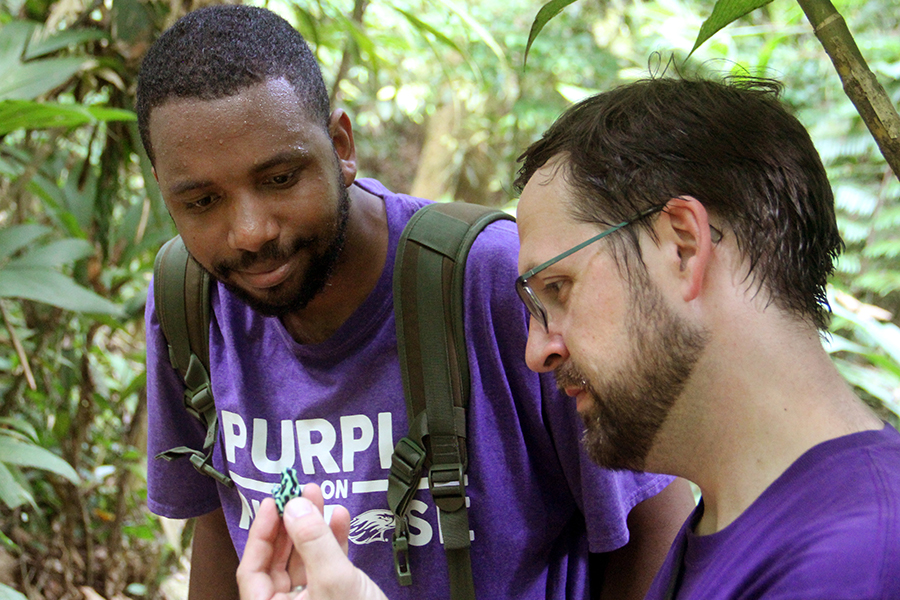
UW-Whitewater student Miles McIntosh, left, a geography major, looks at a poison dart frog with Associate Professor of Biology Brian O’Neill. McIntosh worked on O’Neill’s team, studying animal movements across rivers.
From beetles to bridges
Limón Ramirez, a senior majoring in biology with an emphasis on cell physiology, was born in Jalisco, Mexico. Her family moved to the U.S. when she was four years old, and she grew up in Lake Geneva and attended Badger High School. She studied scavenging beetles as part of Romero’s research team.
“We set out dead, frozen mice every 50 meters. We would tie dental floss around them, and see how long it took for something to eat them or take them. More than 50% were taken by beetles and buried, and we measured the depth,” she said.
McIntosh, a junior majoring in geography with an emphasis on geology, worked on O’Neill’s team, which studied animal movement to see if they used natural bridges, such as trees, or human-made bridges to cross rivers.
“We set up 17 trail cameras on man-made bridges,” McIntosh said. “Every day, we went out to check the cameras, look for photos of animals and mark them on a list. There was a good variety of predators and prey, big and small.”
The rainforest provided a living laboratory teeming with inhabitants that the students never expected to see in their natural surroundings. Howler monkeys, spider monkeys, and white-faced capuchins populated the forest trails.
“They were swinging above us or just sitting there, eating. It was mind-blowing,” Limón Ramirez said. “We got to see a sloth — my favorite animal. It was hanging on a tree next to a bridge, and we saw it really close up. It was amazing.”
Lizards and amphibians abounded, including colorful poison dart frogs and yellow viper snakes that wind around tree branches. REU program leaders prepared the students well.
“We had to be careful walking through trees,” said Limón Ramirez. “Before we were anywhere near the forest, they taught us how to stay safe.”
McIntosh, who was born in Pittsburgh and grew up in Gurnee, Illinois, says adjusting to the rainforest climate took some time.
“Every day, it was 90 degrees or higher, with 100% humidity,” he said.
The farther into the forest, the more animals appeared. And the field cameras captured some surprises.
“A puma showed up on two cameras. We also saw squirrels, skunks, porcupines, opossums, monkeys, ocelots, and tayras (from the weasel family),” McIntosh said.

UW-Whitewater student Tania Limón Ramirez, a biology major, conducts research in La Selva Biological Station in Costa Rica in the summer of 2023.