In-school partnership benefits UW-Whitewater students, local community
February 26, 2026
Written by Abigail Dotzler | Photos by Craig Schreiner, submitted
The best way to learn how to change lives is to start doing it now. For a future speech-language pathologist, there’s a monumental difference between reading about textbook “intervention strategies” and actually helping a child master reading and math.
At Purdy Elementary in Fort Atkinson, college students like Lillian Groblewski are earning real-world experience long before graduation through a unique collaboration between the University of Wisconsin-Whitewater and Flourishing Next Steps. They’re bridging the gap between theory and practice and building their professional confidence one after-school session at a time.
As part of the Communication Sciences and Disorders (COMDIS) program’s emphasis on hands-on learning, students take two credits of an experiential learning requirement, which can manifest as an internship, an independent study, a travel study, or a field study.
While university-facilitated field studies are common in the graduate program, the department is proud to offer a field study for undergraduate students as well. By collaborating with Flourishing Next Steps at Purdy Elementary School, the program is supporting students’ professional development, or “scaffolding student success,” according to Lynn Gilbertson, COMDIS department chair and professor of communicative disorders.
As schools are the top employment setting for speech-language pathologists, Flourishing Next Steps is an ideal fit to introduce students to their most likely professional environment.
The after-school program is for children between kindergarten and second grade in the Fort Atkinson school district, less than 10 miles from campus. The program uses interactive activities and play to promote learning and social and emotional development.
“Students participate in hands-on, applied experiences that are relevant to the field, by working with different kinds of client populations or other professionals that they'll be collaborating with and teaming with when they are speech-language pathologists or audiologists in the future,” said Gilbertson.
In December 2025, Lillian Groblewski completed her second semester volunteering at Flourishing Next Steps. She assisted interventionalists in developing reading, writing, and math skills in the students.
While weighing the career options of teaching or pediatrics, Groblewski, a junior and a first-generation college student from Lake Villa, Illinois, stumbled upon UW-Whitewater’s COMDIS program, which she sees as the perfect blend between the two.
“It also was really important for me that [I would be] able to give back or have more sense of purpose in my job,” she said, “and I found it with the major.”

Lillian Groblewski, a communication sciences and disorders student from Lake Villa, Illinois, meets up with friends in the University Center on Monday, Jan. 27, 2025. (UW-Whitewater photo/Craig Schreiner)
She and other “bigs” — as Flourishing Next Steps terms those who work with the children — from the COMDIS department volunteer twice a week at Purdy Elementary School, earning 45 hours of experience per semester.
During twice-daily debriefs, the Flourishing Next Steps coordinators offer feedback and strategies for implementing new tools. They provide the volunteers with learning targets to work toward with the children, and guide the volunteers through the hands-on activities.
Groblewski loves seeing behind the scenes of how a program like Flourishing Next Steps is run, and this real-world experience has given her a new perspective on her coursework.
“I’m not just going to class. I’m going to get something out of this,” she said.

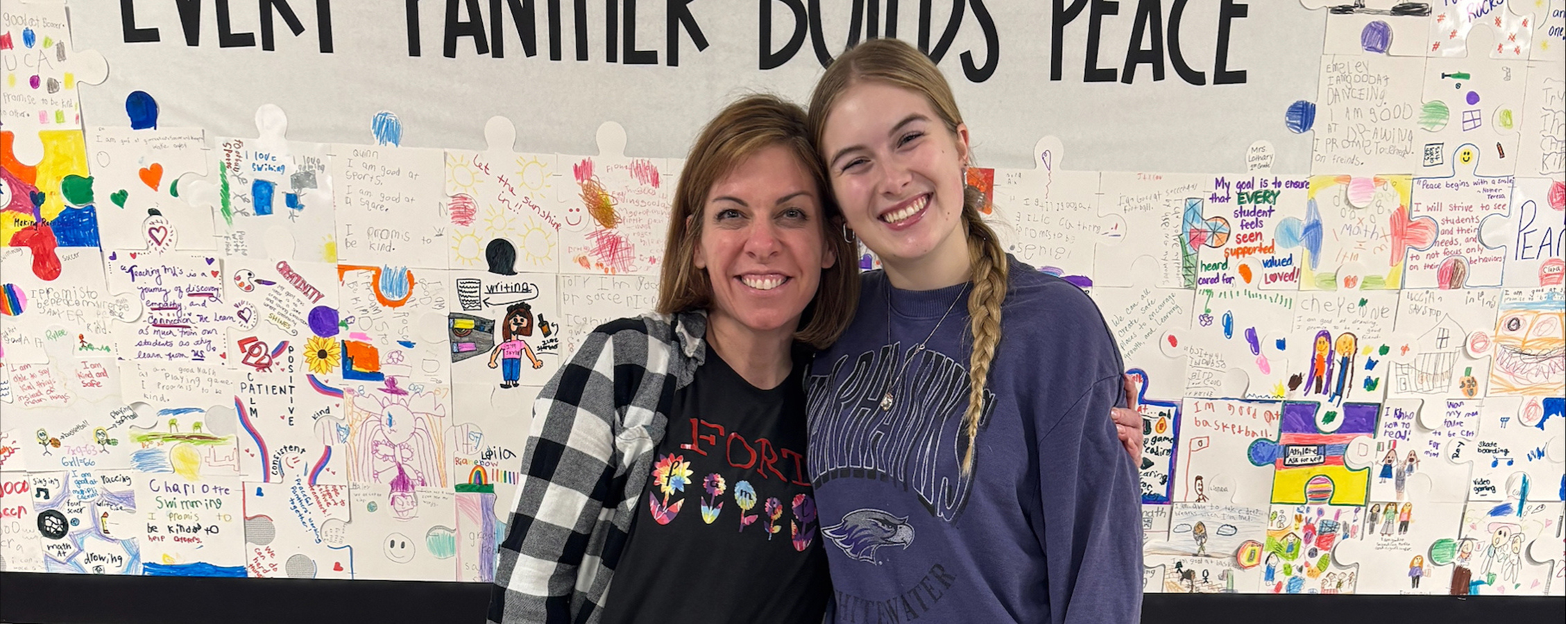
Pictured left: Lillian Groblewski, at right, pictured at Purdy Elementary School, home of Flourishing Next Steps, with program coordinator Molly Fuller. (Submitted photo)
Groblewski sees the strategies she learns in the classroom play out in real life at Flourishing Next Steps as the children’s performance improves. The strategies and techniques students are learning aren’t limited to their field studies — they can apply them in their careers as well.
Gilbertson highlighted the behavior management skills, intervention strategies, and professional connections that students develop through the field study and stressed that each student chooses their own goals for their field study. By collaborating with their supervisors and with Gilbertson and her team, students can individualize their experience and learning.
Beyond the classroom, COMDIS students gain confidence and a sense of community. Groblewski stressed the greater purpose she feels on campus, too, as a result of her field study. Because of the opportunities afforded by their field study, students are able to branch out, get involved, and make a difference in the community beyond the university.
In the spring 2026 semester, COMDIS students continue to work with Flourishing Next Steps, through both the field study and independent studies. The program has become an invaluable partner for the COMDIS department.
Gilbertson and the COMDIS department are open to expanding their undergraduate field studies and encourage those with ideas to reach out.
“We are really excited to work with our communities surrounding us to facilitate career readiness and student learning.”