FRESHWATER PROGRAMS AND RESEARCH
In a world where every drop of water counts, UW-Whitewater faculty and students are asking important questions. And what better place to seek the answers than the classrooms, laboratories, and research settings connected with a university with “water” in its very name.
You’ll find a confluence of academic programs at UW-Whitewater — from freshwater science to sustainability to business — all of which contribute new knowledge, technological advancement and economic development opportunities.
UW-Whitewater is also a member of the Freshwater Collaborative of Wisconsin, a partnership that provides students with opportunities for water-related coursework, hands-on experiences, internships and research opportunities at the 13 Universities of Wisconsin.
What our students do
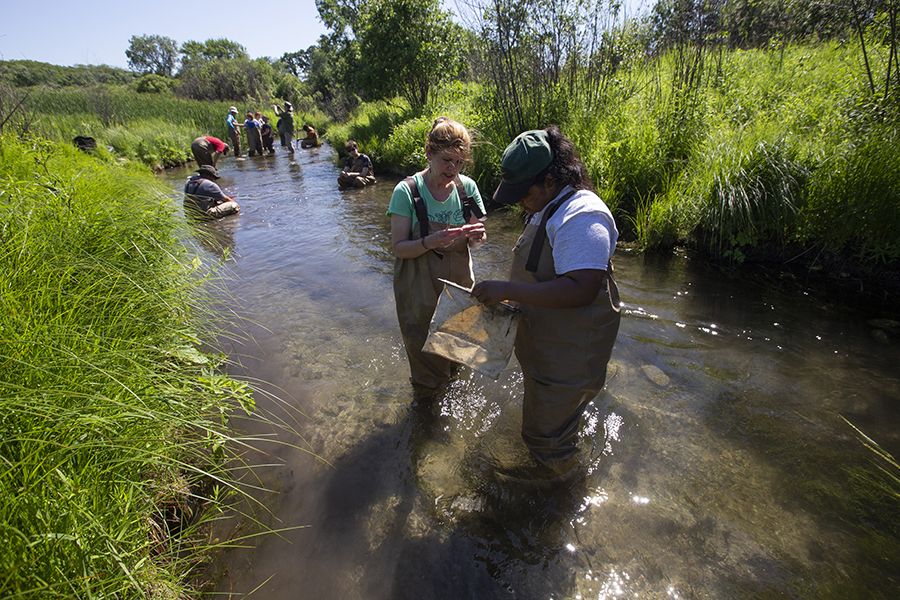
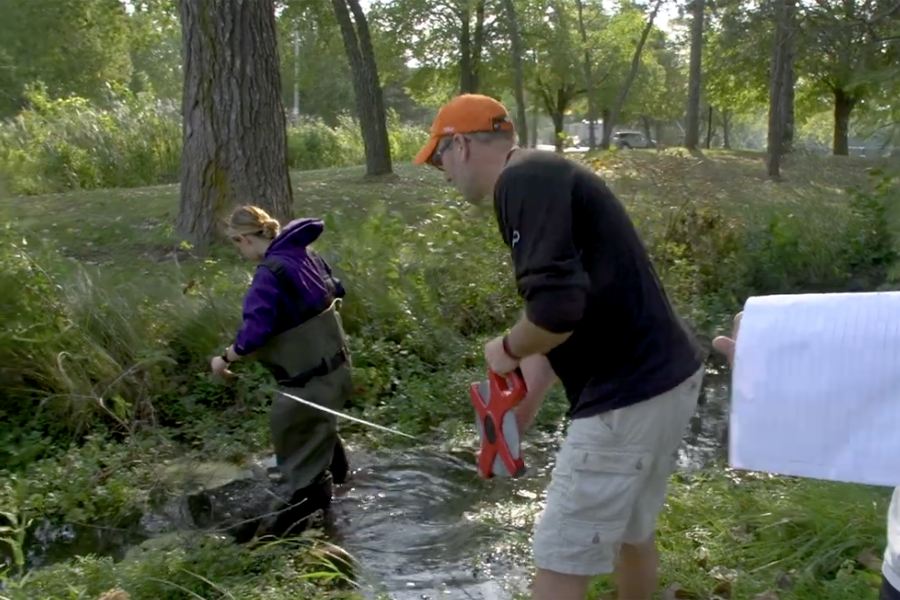
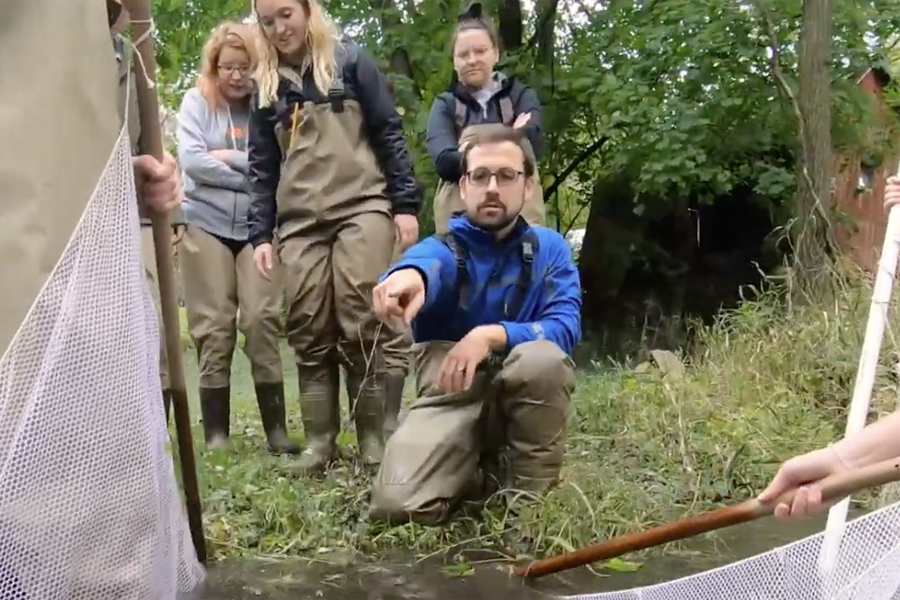
 Go into the Wisconsin great outdoors for field experiences
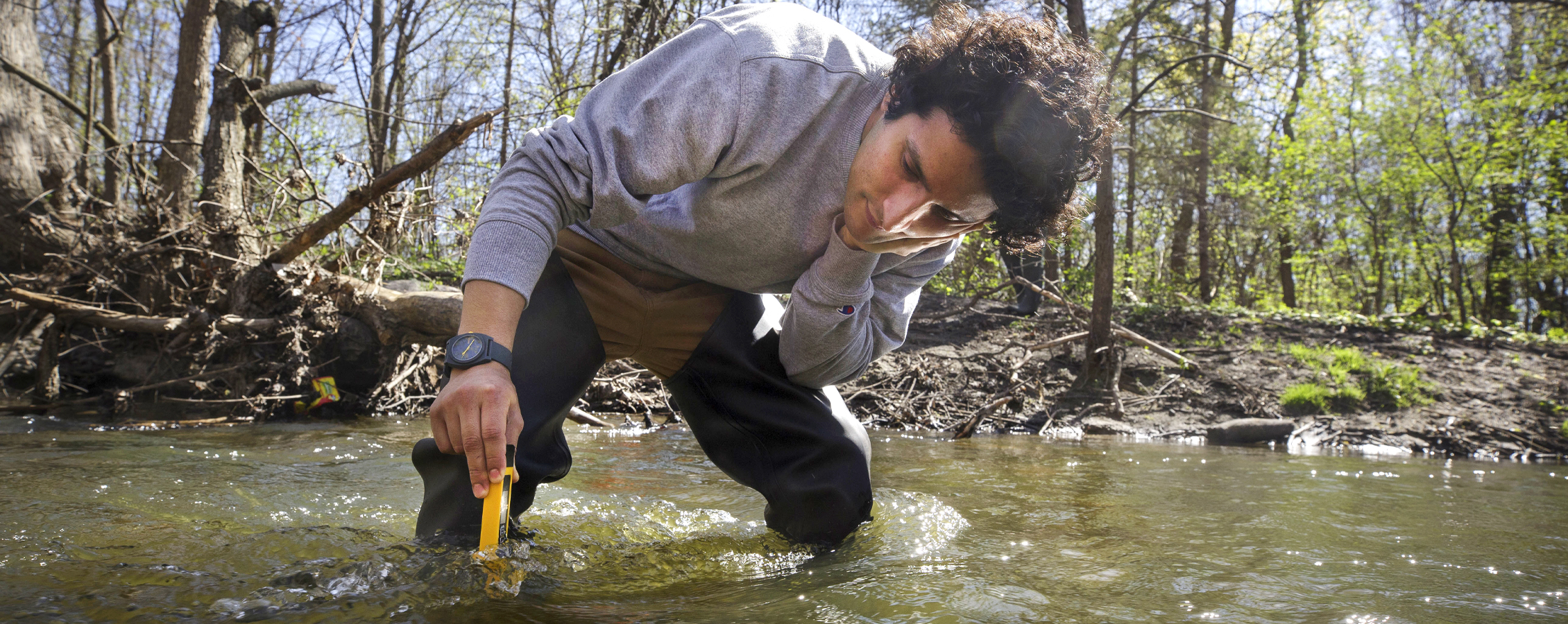
 Gain hands-on experience through research and internships
 Learn and experiment in modern laboratories
Water-focused programs

From the inland and Great Lakes waters of Wisconsin to the deep waters of the South Pacific, students who study marine biology and freshwater ecology at UW-Whitewater will have plenty of places and opportunities to get their feet wet. Courses in ecology and aquatic biology offer freshwater field experiences at wetlands, lakes, streams, and rivers, including those that are part of State Natural Areas located in the Kettle Moraine State Forest. Students who choose this major also spend two semesters studying abroad at Deakin University in Australia, where they take courses in marine biology and oceanography and gain additional hands-on field experience in saltwater ecosystems.
Students in this program are well-prepared for graduate school and for careers in:
- Research
- State agencies and federal agencies such as the National Oceanographic and Atmospheric Administration
- Aquariums
- Water and wastewater treatment facilities
- Nonprofits such as Trout Unlimited
Find out more about Biology with an emphasis in Marine Biology and Freshwater Ecology »
Among its biology degree options, UW-Whitewater offers a well-rounded major in ecology, evolution and behavior. This versatile degree program allows students to choose among courses in community ecology, wildlife ecology, aquatic biology, evolution, conservation biology, environmental toxicology, and animal physiology and behavior.
Students in the program are well-prepared for graduate school and for careers in:
- Research
- With state agencies and federal agencies such as the U.S. Fish and Wildlife Service
- Environmental consulting and remediation and restoration firms
- Nonprofits such as the Sierra Club
Find out more about Biology with an emphasis in Ecology, Evolution, and Behavior »
Students who choose an emphasis in Natural Science focus on courses in biological, chemical and physical sciences such as ecology, environmental toxicology, and oceanography. They gain valuable hands-on skills in the field and in the lab and participate in a capstone course where they work with other students from each of the three environmental science emphases to conduct research on a real-world, local environmental issue.
Our students leave UW-Whitewater as broadly trained environmental scientists with strong technical and communication skills.
Find out more about Environmental Science with an emphasis in Natural Resources »
Students who choose an emphasis in Sustainability and Environmental Resource Management explore environmental ethics and policy issues, including water policy, and best practices in sustainability and resource management, including water resources management. They participate in a capstone course where they work with other students from each of the three environmental science emphases to conduct research on a real-world, local environmental issue.
Our students leave UW-Whitewater as broadly trained environmental scientists with strong technical and communication skills.
Students completing the Integrated Science and Business major, which was designed to equip students to compete and prosper in the new technology-intensive, global marketplace, have the option to add a water resources emphasis. Water scarcity, pollution, climate change, and other problematic global water trends pose major challenges and opportunities to businesses and will continue to do so in the years ahead. What better place than Wisconsin, known for its water-related manufacturing and research, to access such expertise and take advantage of regional opportunities in business and science?
Find out more about Integrated Science-Business with an emphasis in Water Resources »
This program combines a basic grounding in the sciences with an opportunity to learn in a one-on-one setting with leading business faculty who are experts in environmental and water issues in business. This program offers students the opportunity to craft an individualized program of study that fits their specific interests and career goals in the broad area of water business.
Institute for Water Business
The Institute for Water Business seeks to engage, educate, and empower key stakeholders through learning, research, and outreach. The institute brings people together, fostering alliances among students, faculty and staff, businesses, governments, and civil society, to exchange information and dialogue and to collaborate on freshwater challenges. IWB is focused on delivering information about water-based issues to people and businesses in Wisconsin and around the globe.
Freshwater grants
UW-Whitewater participates in a variety of grant-funded water research projects, from creating a Freshwater Summer Camp to developing a toolkit designed to measure the effects of water cleanup and restoration projects on a community's economic vitality.
Grant-funded water research projects at UW-Whitewater
Faculty developed an interdisciplinary course in aquatic biogeochemistry utilizing UW-Whitewater’s analytical instrumentation and equipment and blending the expertise of current faculty (in limnology, wetlands, stream ecology, marine biology, aquatic toxicology and fluvial geomorphology) to offer hands-on training and immersion in aquatic biogeochemistry. The course was specifically designed to bring local government and organizations into the classroom and field to help students connect with the community.
In this collaborative project with UW-La Crosse and UW-Milwaukee, Faculty developed a two-course series focused on water pollution and its effects on environmental and human health, including an online, two-credit, introductory-level course and a three-credit field and lab course. Students learn about major contaminant classes and methods for testing contaminant toxicity, including those contaminants associated with agricultural water management and wastewater treatment. They will also learn how environmental legislation relates to water-quality criteria, Superfund sites, and mitigation and restoration of contaminated sites.
Biology faculty member Elisabeth Harrahy received two grants to work with undergraduate students on toxicity tests to determine the effects of a mixture of two neonicotinoids on two aquatic organisms. The data were added to a larger collaborative project with UW-La Crosse and UW-Madison and summarized in a report to the Wisconsin Department of Agriculture, Trade and Consumer Protection.
Students in the UW-Whitewater Fiscal and Economic Research Center conducted research through the Institute for Water Business on the efficiency of water utilities, leveraging previous research to identify how costs incurred by water districts in cleaning water leads to inefficiency and increased prices. This research sought to identify the cost of remediation to provide regulators the information necessary to make informed determinations regarding contaminant assessments. Read about FERC water-related research.
UW-Parkside and UW-Whitewater created a program highlighting important freshwater habitats, building participants’ confidence and skills with hands-on field and laboratory activities, and presenting information on freshwater career and training opportunities to an initial cohort of high school juniors from southeastern Wisconsin. Students collected fish and macroinvertebrate samples, measured water-quality parameters, learned about shoreland restoration and went paddling (many for the first time). They also learned about a variety of careers associated with the water sector and discussed how some businesses involve the use of water. Read more about the program.
In collaboration with UW-Green Bay, economics faculty led this effort to quantify the total economic value of the freshwater fishery resources of Lake Michigan and Bay of Green Bay to the state of Wisconsin, analyzing how different fishery management strategies and climate change scenarios may affect the quality, and therefore economic value, of these resources. The team engaged external constituencies, including the WDNR, the Lake Michigan Commercial Fishing Board, recreational anglers, charter guides, and private companies, in real-world applied research relevant to the management of the fisheries. External stakeholders, such as the WDNR and state legislature, will use this research to help inform and guide future management and policy.
What our graduates do
 Pursue graduate degrees
 Research our ecosystems
 Work to conserve our natural resources
 Water business and natural resource economics
Contact us
Elisabeth Harrahy, Ph.D.
harrahye@uww.edu | 262-472-1086