Undergraduate research launches UW-Whitewater alum into dream career
December 01, 2025
Written by Chris Lindeke | Photos by Craig Schreiner, Kyle Winter | Video by Kyle Winter
Undergraduate research at the University of Wisconsin-Whitewater delivers a unique combination of hands-on learning, individual subject-matter training, and professional networking and development.
The Undergraduate Research, Innovative, and Creative Activities (URICA) program at UW-Whitewater pairs students with faculty mentors who have ongoing research projects. The students work 1:1 with the faculty member to assist with research and develop critical soft skills — including communication, critical thinking and problem solving.
“It’s doing those undergraduate research projects, working a little bit independently on that, that’s going to build those skills that employers are going to look for in the future,” said John Frye, director of the Undergraduate Research, Innovative, and Creative Activities program and associate professor of geography and geology.

John Frye, left, associate professor of geography and geology, talks with admitted student Grace Redman about undergraduate research opportunities during Admitted Student Day on Friday, Nov. 14, 2025. (UW-Whitewater/Craig Schreiner)
After they work on their faculty member’s project, students are encouraged to build and execute their own research project — on any subject or topic — under the guidance of a faculty member.
The URICA program supports any type of research by students of any major for the duration of their projects. Students can join the program the day they step on campus and be a part of it until the day they graduate.
Beginning students can sign up for the Research Apprenticeship Program (RAP) and apply for other grants and programs, including the highly competitive Summer Undergraduate Research Fellowship (SURF) program.
“Whether you want to work a semester or a full academic year, or even the full (calendar) year, we have something for you in undergraduate research,” Frye said.
Sometimes, undergraduate research leads to extraordinary opportunities in the field. For one Warhawk, that opportunity led to a fulfilling career in one of the country’s most beautiful geographic areas.
Tyler Brasington grew up in southeastern Pennsylvania, and his family had a cabin in the Pocono Mountains, located just to the north. He regularly saw black bears in the mountain range when he was a young child.
Brasington and his family moved to Wisconsin, and he graduated from Waukesha North High School. Without a clear idea of what he wanted to do for his career, Brasington enrolled at UW-Whitewater before leaving school and enlisting in the military.
After realizing that path wasn’t for him, Brasington returned to the university and headed on a “sabbatical” out west, backpacking three different national parks — Grand Teton, Yellowstone, and Glacier. He saw his first grizzly bears at Glacier National Park.
“It intrigued me how bears could occupy the same spaces as humans, and coexist without creating issues,” he said. “That set the tone for me going forward.”
Brasington’s work in undergraduate research laid the groundwork for his career.
He was connected to Yellowstone by George Clokey, a beloved faculty member in the biology department who conducted an annual faculty-led travel study at the national park.

Tyler Brasington is interviewed on the Whitewater campus on April 25, 2025. (UW-Whitewater photo/Kyle Winter)
After taking part in the travel study, Brasington was connected by Clokey to James Halfpenny, one of the world’s leading experts on animal tracking. Brasington then developed a proposal that led to his undergraduate research, working with Halfpenny and undergraduate research advisor Dale Splinter to study grizzly bear distribution in the northern range of Yellowstone.
“It’s the ultimate success story for undergraduate research,” Frye said. “That’s where Tyler really got his start diving into wildlife management, bear management.”
Brasington, who earned a B.S. in environmental science from UW-Whitewater in 2017, was hired before graduation by the National Park Service and has built a career working in nature following his experiences in undergraduate research. He continues to work at Grand Teton National Park in Wyoming as a bear management park ranger and emergency medical technician.

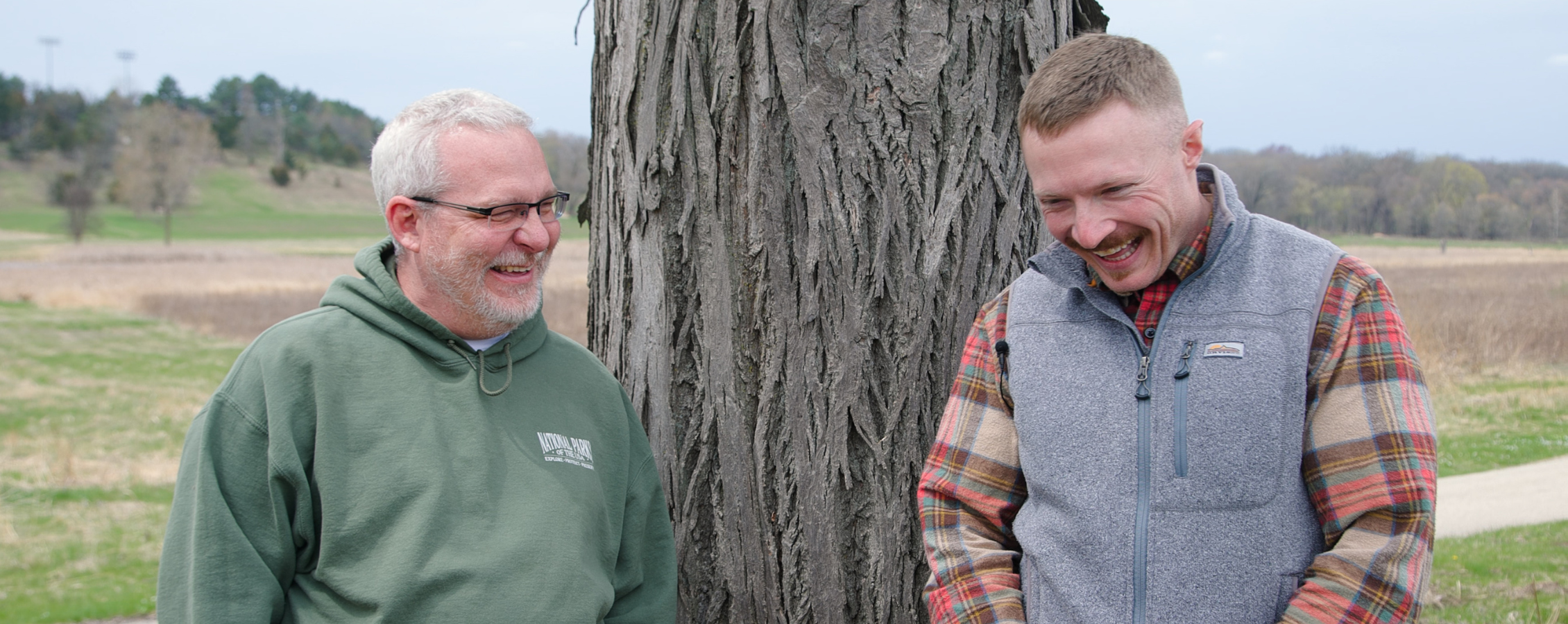
UW-Whitewater alum Tyler Brasington, left, and John Frye, UW-Whitewater director of the Undergraduate Research Program and associate professor of geography and geology, hold a conversation while on a walk through the Whitewater campus on April 25, 2025. Brasington was recognized the next day at UW-Whitewater’s Founders Day Celebration. (UW-Whitewater photo/Kyle Winter)
Brasington has remained involved with the university as a guest lecturer and presenter, and regularly works with Frye to mentor students engaged in undergraduate research. He was named UW-Whitewater’s Outstanding Recent Alumnus in 2025.
Both Frye and Brasington emphasized the importance of building relationships in undergraduate research — Brasington’s close relationship with Clokey held beyond Clokey’s retirement in 2021 and until his passing in March 2025.
“The relationships between students and faculty members, it really sets the tone for future opportunities and endeavors down the road,” Brasington said. “My relationships with faculty on campus have been the reason why I'm still so involved with campus. It’s being able to maintain those relationships and give back, because the university gave me so much with those opportunities they presented.”
Frye now oversees the annual travel study to Yellowstone, which is set to take place again in 2026. He was emotional when discussing Brasington’s connection to the university and willingness to give back like so many students who conducted undergraduate research do.
“In the way that Dr. Halfpenny was a mentor, (Tyler is) now that mentor for my students,” Frye said. “It’s really coming full circle.”